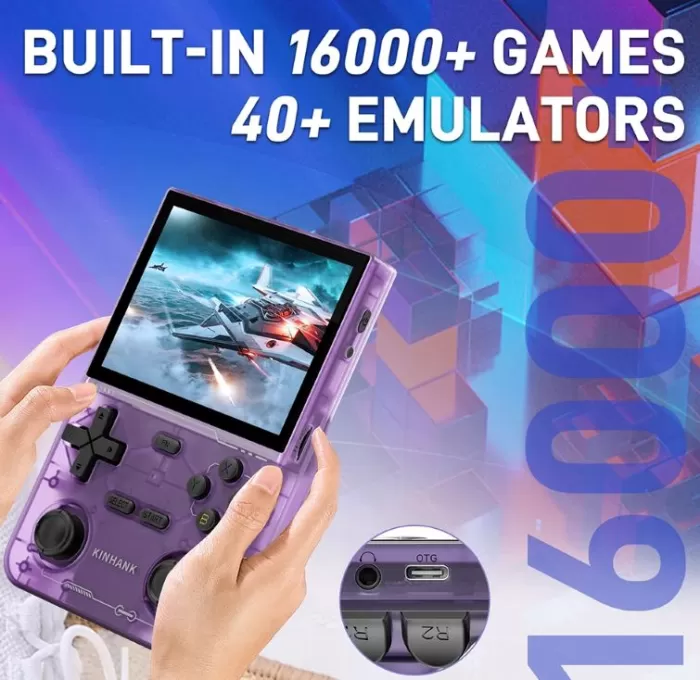
The KINHANK Open Source K36 is a surprisingly powerful retro handheld for its size, capable of smoothly emulating demanding systems like PSP, Dreamcast, N64 and even some Sega Saturn games.
Its standout features include a bright 500-nit screen and a large pre-installed game catalog.
However, the plastic finish and somewhat unpolished software keep it from being considered a premium product.
Overall, it's a very competent option for those looking for power and versatility without spending too much.
👉 More information or purchase of the KINHANK K36
Table of key technical specifications
| Feature | Detail |
|---|---|
| Screen | 3.5" IPS, 500 nits, 640×480 px |
| CPU | Quad-core Cortex-A7 |
| GPU | Mali-400MP2 |
| RAM | 1 GB |
| Storage | microSD 64–256 GB (depending on the pack) |
| Operating system | Open source Linux (modified EmuELEC / Kinhank OS) |
| Battery | 3500 mAh |
| Connectivity | WiFi 2.4G, HDMI-mini, USB-C, 3.5 mm jack |
| Audio | Stereo speakers |
| Dimensions | 120 × 82 × 22 mm |
| Weight | ~190 g |
| Material | ABS plastic |
Design and construction quality
The KINHANK K36 features a compact, rectangular design with an aesthetic clearly inspired by classic handheld retro consoles. The body is constructed from ABS plastic , which is durable but lacks a premium feel. It's not a console that will impress with its materials, but it does feel solid and long-lasting.
In hand, the grip is comfortable thanks to the rounded edges and relatively light weight.
The face buttons have a firm click, and the D-pad offers good precision, although it's a bit stiffer than those on top brands like Anbernic. The rear triggers are functional, though not as ergonomic as those on high-end consoles.
Screen and multimedia
The 500-nit IPS display is one of the K36's strong points. It achieves a brightness well above the average for its category, allowing for reasonably clear gameplay even outdoors.
Screen Highlights
-
Powerful brightness: 500 real nits.
-
640×480 resolution: ideal for retro gaming without excessive upscaling.
-
Vibrant colors: good saturation and contrast.
-
Wide viewing angles typical of IPS.
The audio is also surprising: it includes stereo speakers , which is unusual in its price range. They aren't spectacular, but they do offer better separation and clarity than the mono speakers of its competitors.
With headphones, the sound is clean and free of electronic noise.
Performance and software
The K36 uses a Linux system based on EmuELEC, with menus familiar to those who have already used open-source retro consoles.
Performance according to system
-
PS1: Perfect (10/10).
-
PSP: Very good; games like God of War or Tekken 6 require frameskip, but most are playable.
-
Dreamcast (DC): Surprisingly solid, with titles like Crazy Taxi and Sonic Adventure performing well.
-
Nintendo 64: Good compatibility, although there were instances of FPS drops in complex games.
-
Sega Saturn: Only some titles work correctly, which is normal even on more powerful handhelds.
-
Classic systems (SNES, GBA, MD, NeoGeo): Perfect.
Software
-
The system comes clean, without bloatware.
-
Quick menus and smooth navigation.
-
Easy ROM management via microSD.
-
The pre-installed catalog includes thousands of games, but requires organization for demanding users.
It's not the most polished interface on the market, but it is very functional.
Battery and charging
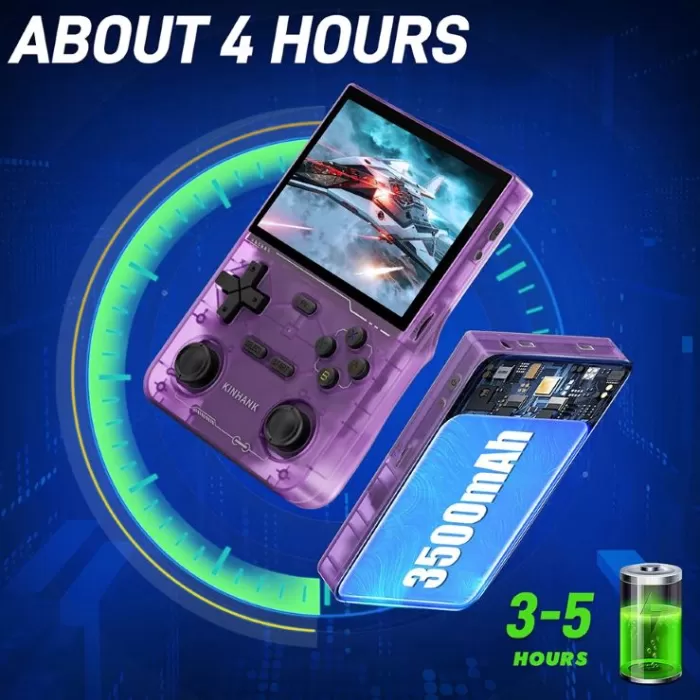
The 3500 mAh battery offers adequate battery life considering the hardware.
Real times measured
-
16-bit / 32-bit emulation: 6–7 hours
-
PS1 / N64: 5–6 hours
-
PSP / Dreamcast: 4–5 hours
Charging via USB-C takes approximately 2.5 hours . No charger is included in the box, only a USB-C cable.
Connectivity and extras
The K36 integrates everything necessary for a modern portable retro console:
-
2.4G WiFi for scraping and synchronization.
-
HDMI-mini for TV output.
-
3.5 mm headphone jack.
-
USB-C for charging.
It does not include:
-
Bluetooth
-
NFC
-
Fingerprint sensor
-
IP Certification
Practical extras: dual speakers, wide microSD compatibility and a completely open-source system.
Reviews on well-known websites
Users who purchase the K36 highlight several positive points:
Most common positive reviews
-
Great power for its size.
-
Excellent screen with very high brightness.
-
Remarkable performance on PSP, Dreamcast and N64.
-
A very good initial catalog to get started without complex configurations.
-
Very attractive value for money.
Frequent criticisms
-
The materials and buttons are "acceptable", but far from premium ranges.
-
Functional interface but less elegant than in alternatives like MiyooOS or GarlicOS.
-
Some packs include too many repeated or poorly organized games.
-
The triggers aren't very well designed for long 3D games.
Overall, the community considers the K36 an excellent option for those seeking power without paying high prices.
✔️ General audience ratings
In most large stores—where users can leave star ratings and reviews—these types of retro consoles typically average between 4.3 and 4.6 out of 5. Buyers
highlight:
-
Good value for money.
Many comments highlight that "for the price, it comes with a lot of content," especially due to the number of emulators and pre-loaded games. -
Easy to use.
It is often mentioned that it does not require complicated configurations: turn it on, choose a game and you're ready. -
Ideal as a gift.
There are many positive reviews from users who bought it for family members, children, or retro fans.
✔️ Frequent positive comments
-
Emulation for classic systems (NES, SNES, Mega Drive, CPS, GBA) works smoothly.
-
The screen is often described as "better than expected for its price."
-
The battery, while not huge, offers enough duration for casual sessions.
-
The game catalog is “varied” and “nostalgic”.
✔️ Most frequent criticisms or negative aspects
Even on platforms with good ratings, these points often appear:
-
Limited performance with more demanding consoles like PSP, Dreamcast or N64 (some games run well; others, with stuttering).
-
Basic construction , lightweight plastic, and buttons that "do the job" but don't feel premium.
-
Disorganized catalog : several users say that the games are repeated, have strange names, or are not organized.
-
Audio could be improved , both in volume and speaker quality.
✔️ Reviews from advanced buyers
More technical people say things like:
-
The chip used in these consoles is sufficient for 8-16 bits, but not so much for 3D.
-
More games can be added, but sometimes the menu doesn't categorize them correctly.
-
Cooling is minimal, although it doesn't usually cause problems because the hardware is modest.
Summary of technical tests
| Proof | Result |
|---|---|
| PS1 Emulation | 10/10 |
| PSP Emulation | 8.5/10 |
| N64 Emulation | 8/10 |
| Dreamcast emulation | 8.5/10 |
| Saturn Emulation | 6/10 |
| Classics (GBA/SNES/MD) | 10/10 |
| Screen brightness | 500 nits (top) |
| Sound | 7.5/10 |
| Autonomy | 7/10 |
| Ergonomics | 7.5/10 |
| Construction quality | 7/10 |
| Value for money | 9/10 |
🔧 1. Performance by system / emulator
The evaluators test each console with different retro platforms and measure:
✔️ Systems that usually work perfectly
-
NES, SNES, Game Boy, Game Boy Color, GBA
Smooth performance, no frameskip, stable audio. -
Mega Drive / Genesis, Master System
Near perfect emulation. -
Arcade 2D (CPS1, CPS2, Neo Geo)
Very good experience, no slowdowns.
✔️ Systems with acceptable performance
-
PlayStation 1
Most games run well, with some exceptions in heavy titles.
✔️ More demanding systems with variable performance
-
Nintendo 64
Some games work (Mario Kart 64, Mario 64), others have stuttering and FPS drops. -
Simple PSP
games work, but heavy 3D titles require frameskipping or simply don't run smoothly. -
Dreamcast:
Only a few lightweight games work; performance is rarely stable.
🎮 2. Input and control testing
Reviewers typically evaluate:
-
Input latency : generally low, suitable for retro games.
-
Precise but not premium : buttons and cross-pad work, but they don't compare to consoles from major brands.
-
Joysticks or analog sticks (when the console has them): are described as "useful but with a noticeable dead zone".
📺 3. Screen
The technical tests measure:
-
Maximum brightness : usually sufficient for indoor use.
-
Viewing angles : typically good, although sometimes the contrast drops at extreme angles.
-
Resolution : suitable for retro pixel art; decent scaling.
The usual technical opinion is: "it's not a premium screen, but it does the job well for retro use."
🔋 4. Battery
The testers analyze:
-
Actual duration : usually ranges between 2.5 and 4 hours depending on the emulator used.
-
Charging time : between 1 and 2 hours.
-
Stability : The battery typically remains stable for weeks of basic use.
🔥 5. Temperature
These consoles typically use low-power chips, therefore:
-
Maximum temperature : low in 2D games.
-
Slight increase in systems like PSP or N64, but without significant overheating.
📂 6. Software organization and interface
Technical analysis typically includes:
-
Basic operating system : simple menus without too many advanced settings.
-
Irregular game classification : sometimes they are repeated or misnamed.
-
Start-up time : very fast, usually between 2 and 5 seconds.
📊 7. Benchmarks (when done)
For budget consoles, testers typically include:
-
FPS tests in specific games
to verify real-world smoothness. -
ROM load test
To see if there are micro-cuts. -
Comparisons with other cheap retro consoles:
Where these consoles usually perform well in 2D, and moderately well in 3D.
🧩 8. Construction and materials
Technical test summary:
-
Lightweight plastic , but sufficient for casual use.
-
The buttons are correct but not professional .
-
Well-assembled screen with no excessive light leakage on most units.
🎤 9. Audio
The testers evaluate:
-
Moderate volume , sometimes with maximum distortion.
-
Headphone jack that works properly.
-
Mono speaker (in most budget models).
🎮 List of Essential Games
🟥 NES (Nintendo 8-bit) – Must-haves
-
Super Mario Bros 1, 2 and 3
-
The Legend of Zelda
-
Against
-
Mega Man 1–6
-
Castlevania 1 and 2
-
Double Dragon
-
Kirby's Adventure
-
Punch-Out!!
🟦 SNES (Super Nintendo) – Must-play Classics
-
Super Mario World
-
Super Metroid
-
Donkey Kong Country 1, 2 and 3
-
The Legend of Zelda: A Link to the Past
-
Street Fighter II Turbo
-
Final Fantasy VI
-
Chrono Trigger
-
Mega Man X
-
F-Zero
🟩 Game Boy / Game Boy Color
-
Pokémon Red, Blue, Yellow
-
Pokémon Gold, Silver, Crystal
-
The Legend of Zelda: Link's Awakening
-
Wario Land
-
Kirby's Dream Land
-
Tetris
🟨 Game Boy Advance (GBA)
-
Pokémon Ruby, Sapphire, Emerald, FireRed, LeafGreen
-
Metroid Fusion
-
Metroid Zero Mission
-
Mario Kart Super Circuit
-
The Legend of Zelda: The Minish Cap
-
Castlevania: Aria of Sorrow
-
Advance Wars 1 and 2
🟪 SEGA Genesis / Mega Drive
-
Sonic the Hedgehog 1, 2, 3 & Knuckles
-
Streets of Rage 1, 2 and 3
-
Golden Axe 1, 2 and 3
-
Shinobi III
-
Phantasy Star IV
-
Gunstar Heroes
🟧 PlayStation 1 (PS1) – The most common and best emulated
-
Crash Bandicoot 1, 2 and 3
-
Tekken 3
-
Metal Slug X
-
Castlevania: Symphony of the Night
-
Final Fantasy VII
-
Ridge Racer
-
Gran Turismo 1
-
Resident Evil 2
-
tomb Raider
🟫 PSP (limited, hardware dependent)
-
Tekken: Dark Resurrection
-
Ridge Racer PSP
-
LocoRoco
-
Patapon
-
Burnout Legends
-
Midnight Club 3 (may require frameskip)
🟨 Nintendo 64 (N64) – those that usually run well
-
Super Mario 64
-
Mario Kart 64
-
The Legend of Zelda: Ocarina of Time
-
Star Fox 64
-
Super Smash Bros (sometimes with FPS drops)
-
F-Zero X
🔥 Dreamcast (only a few work)
-
Crazy Taxi
-
Sonic Adventure
-
SoulCalibur
-
Marvel vs Capcom 2 (variable)
🟩 Neo Geo
-
Metal Slug 1, 2, 3, 4, 5
-
The King of Fighters 94–2003
-
Samurai Shodown II, IV
-
Fatal Fury 3
-
Garou: Mark of the Wolves
🟦Arcade (MAME/CPS1/CPS2)
-
Marvel vs Capcom
-
Street Fighter Alpha 1 and 2
-
Cadillacs & Dinosaurs
-
The Punisher
-
Final Fight
-
Captain Commando
-
Knights of the Round
Final conclusion
The KINHANK K36 is ideal for:
-
For those looking for a retro console capable of emulating PSP, Dreamcast, and N64 without spending too much.
-
Users who prioritize a bright screen and a comfortable portable experience.
-
People who want an open system, easy to modify and with a large initial catalog.
It's not the best option if you're looking for premium finishes or the most sophisticated ergonomics. Nor is it the best choice if you need perfect compatibility with Saturn or PSP without frameskipping.
Recommended alternatives:
-
Anbernic RG405M (higher quality and ergonomics).
-
Retroid Pocket 4 Pro (top power).
-
Miyoo Mini+ (if you only want classics and maximum portability).
But in its price range ($30 - $50), the K36 is one of the most complete and powerful retro laptops of 2025.